

10 Architectural Styles, Their Features and Examples 10 Jun
Have you ever wondered whether a building is Modernist or Bauhaus, or whether an imposing façade is Romanesque or Neoclassical? Architectural clues can help, especially when a building has stood through several periods and picked up traces of each. Here are ten major styles and their characteristics.

1. Victorian
In the mid to late nineteenth century, Victorian architecture drew on revivals of Gothic, Tudor and Romanesque styles, as well as Asian and Middle Eastern influences. Many homes built during the Industrial Revolution reflect this mixture.
Key features. Intricate dollhouse-like details, sash and bay windows, asymmetrical forms, two or three storeys, steep and broken rooflines, wraparound porches and vivid colours.
Example. Houses in the United Kingdom, the United States and Australia.

2. Islamic architecture
Islamic architecture originated in the Middle East in the seventh century and took different forms in Persia, North Africa and Spain. Mosques are a defining building type, with pointed arches, domes and courtyards. Restrictions on three-dimensional figurative representation helped make ornament on flat surfaces an important part of the tradition.
Key features. Horseshoe arches, geometric patterns, inward-facing layouts and patterned screens that filter light.
Example. Hui Mosque, China.

3. Romanesque
Romanesque architecture spread across Europe from the late tenth century. In England its Norman variant is well known. Barrel vaults feature prominently in the churches that are among the style’s most enduring examples.
Key features. Barrel vaults, rows of round arches, stylised floral and plant motifs in stone and braided carvings around doorways.
Example. Porto Cathedral, Portugal.

4. Baroque
Baroque architecture emerged in late sixteenth-century Italy as a more expressive and sumptuous style than earlier traditions. Under the influence of the Counter-Reformation, it became a means of celebrating Catholic authority.
Key features. Broken pediments, interrupted forms, elaborate ornament sometimes centred on the façade, paired columns and concave or convex walls.
Example. Palace of Versailles, France.

5. Tudor
Tudor architecture was the last phase of medieval architecture in England, spanning roughly the fifteenth to the early seventeenth century. Its four-centred arch is distinctive, although many people recognise the style by its timber-framed houses.
Key features. Thatched roofs, casement windows with diamond-shaped leaded panes, masonry chimneys and carefully detailed entrances.
Example. Anne Hathaway’s Cottage, Warwickshire, England.
6. Bauhaus
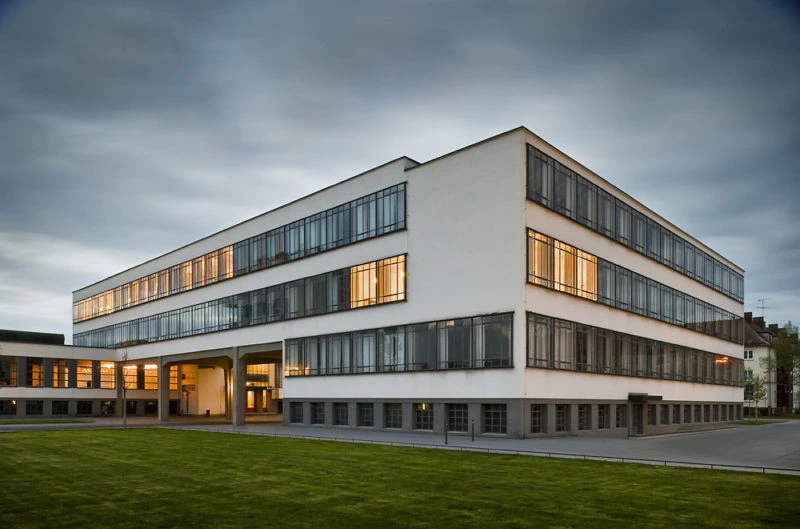
The early twentieth-century German Bauhaus school sought to bring art and technology together through simple design and machine production. The style emphasises function, flat roofs and cubic forms. Its geometry and use of angles are also visible in modern architecture.
Key features. Cubic forms, red, blue and yellow, open floor plans, flat roofs, steel frames and glazed curtain walls.
Example. Bauhaus Dessau, Germany.

7. Neoclassical
From the mid-eighteenth century, Neoclassicism sought to restore dignity and grandeur to architecture after the Baroque and Rococo periods. The buildings of ancient Greece and Rome inspired an emphasis on simplicity and symmetry.
Key features. Monumental scale, plain wall surfaces, prominent columns including decorative examples, and clean lines.
Example. Casino Marino.

8. Renaissance
Renaissance architecture emerged in fifteenth-century Italy under the influence of classical architecture. Designs drawing on Roman remains expressed harmony, clarity and strength and brought classical principles into domestic life.
Key features. Square plans, flat ceilings, classical motifs, arches and domes, Roman-style columns, enclosed gardens and vaulted bays.
Example. St Peter’s Basilica, Vatican City.

9. Gothic
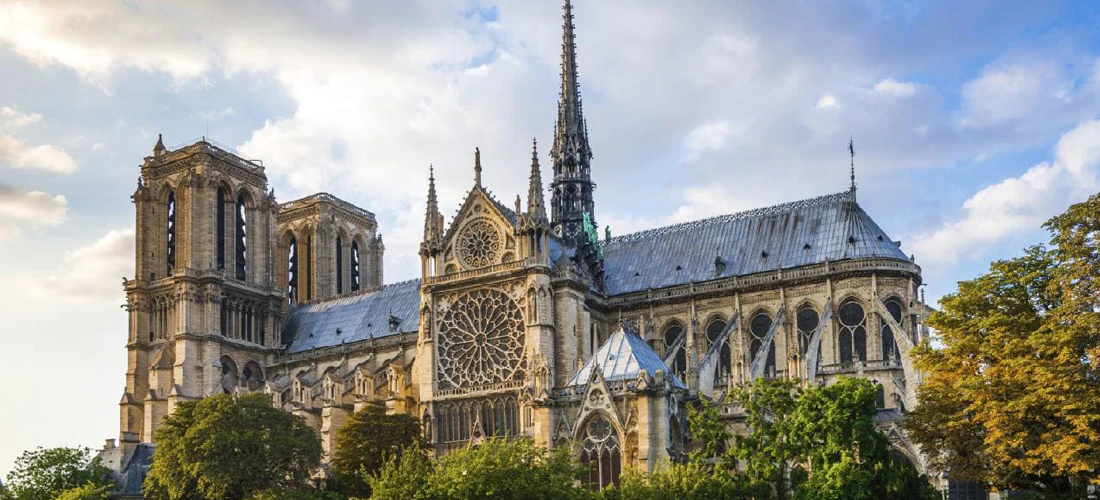
Early twelfth-century Gothic architecture developed features from earlier styles. Finer walls and columns and tall stained-glass windows drew the eye upward, creating a sense of height and lightness.
Key features. Height and grandeur, pointed arches, vaulted ceilings, daylight and an airy structure.
Example. Notre-Dame Cathedral, Paris.

10. Modern architecture
Modern architecture took shape in the twentieth century, when debates around architectural modernity also encompassed movements such as Futurism, Postmodernism and New Classicism. Many modern designs simplified form and used exposed materials to define the appearance of a building.
Key features. Minimal ornament, low-rise forms, modern materials, connections between inside and out, deliberate use of sun and shade, and an emphasis on glass and daylight.
Example. Guggenheim Museum, New York.
No Comments